He cleaned the village with his own hands before he preached.
Maharashtra · a saint with a broom
संत गाडगे बाबा
Sant Gadge Baba
He would not let a village greet him until he had swept its lanes. For fifty years he walked Maharashtra with an earthen pot on his head and a broom in his hand, and he spent other people’s gifts on schools, rest houses, the sick, and animals.
गोपाळा! गोपाळा! देवकीनंदन गोपाळा!
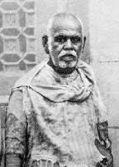
An archival photograph. Patched cloth, a spare body, no ornament. This is how he actually dressed. The gallery below holds the group photographs in which he can be seen clearly.
Begin here
If you remember only this
Gadge Baba is easy to misunderstand if you picture a saint on a throne. Picture a barefoot old man who starts by picking up the dirt.
In one minute. Debuji Zhingraji Janorkar was born in 1876 in a washerman’s farming family at Shendgaon, in Amravati district. In 1905 he left home and walked from village to village. People named him for the earthen pot — the gadge — that he ate from. He cleaned lanes, sang, and held night kirtans against caste, drink, dowry, animal sacrifice and superstition. Gifts of money became public buildings. He died on 20 December 1956 beside the Pedhi river near Walgaon. He said he was nobody’s guru.
He said God lives in people, above all in the poor, not in a stone.
He fought caste insult, alcohol, dowry, debt and the killing of animals in God’s name.
Money given to him became schools, rest houses, food, medicine and shelter for cattle.
He asked for no disciples. Tukaram was his guru. He refused to be one.
At a glance
The person, not the legend
Say his name roughly “Gaad-gay Baa-baa”. Gadge is the pot. Baba means father. Maharaj, in the mouths of villagers, was a title of love, not a throne.
| Born | 23 February 1876, Shendgaon village, Anjangaon Surji taluka, Amravati district. The village name is also written Shengaon or Shedgaon. Then it was Berar Province. |
|---|---|
| Name at birth | Debuji Zhingraji Janorkar. His parents called him Debuji. |
| Parents | Zhingraji and Sakhubai. The Amravati district page says he was their only child. |
| Community | A Parit family — the washerman community — who also farmed. This matters because he spent his life refusing the insult of caste. |
| Marriage | Kuntabai, in 1892. The district page says four children. Some English summaries, including Wikipedia, say three. |
| Left home | 1 February 1905, as later biographies date it. He was about twenty-nine. |
| Died | 20 December 1956, aged 80, on the bank of the Pedhi near Walgaon, also written Valgaon, on the way to Amravati. |
| What he carried | A broom, an earthen pot, and clothes patched from other people’s torn cloth. |
| Line he sang | गोपाळा! गोपाळा! देवकीनंदन गोपाळा! |
The life
From Debuji to the man with the pot
Read it as one story. The dates in the margin are the bones. The paragraphs are the man.
A washerman’s son
Debuji was born into a poor village world. The Amravati district page, which still keeps the official local account, asks us to picture it honestly. Many people had no school. They prayed to village goddesses such as Mariaai and Shitala. Goats and hens were killed in the hope of a cure, or a crop. He grew up inside that world, and he spent the rest of his life arguing with its cruelties, not with its people.
His father died while he was still young. Sakhubai took him to her brother’s house at Dapuri, in Murtizapur taluka. The uncle had land. There the boy became a capable farmer, a herdsman, a singer and a swimmer. He loved cattle. Even then, the district account says, he would not join an animal sacrifice. He preferred the anger of relatives to the killing.
One story on that same page has the hardness of his later life already in it. A moneylender came with guards to seize the farm. The family and the village were afraid. Debuji faced them alone.
The house he left
In 1892 he married Kuntabai. The biographies agree on the break, if not on every private detail. On 1 February 1905 he walked away from the life of a householder. He was not going to a monastery. He was going onto the road, and he stayed on it until he died.
That choice had a cost, and it should be said plainly. A wife and children remained behind. He did not build his public life out of comfort. The shape of the life is not in doubt: he chose service and extreme poverty over the house.
How the pot became a name
On the road he owned almost nothing. He wore a patchwork of cloth other people had finished with. He ate and drank from one earthen pot, and he often carried that pot on his head. In Marathi the pot is a gadge. Villagers started calling him Gadge Baba. Baba is father. Maharaj came later, the way people in Maharashtra name a saint who rules nothing except their affection.
The broom was the other half of the name he earned. He is remembered walking into a village and beginning at once on the gutters and the roads. He began with the lanes of people others would not touch. If someone hurried up with a garland, he told them to wait. Congratulations could come after the work.
Their greetings would have to wait until his work was done.
How his arrivals are described, again and again, from the village lanes to the short English lives.
Fifty years of the same work
From 1905 to 1956 is about fifty-one years. He swept, and he sang “Gopala! Gopala! Devakinandan Gopala!” so that sweeping would become a crowd’s work. Gopala is a name of Krishna, son of Devaki. The line is devotion. It is also a work song.
When the lanes were cleaner there was often a meal that caste was not allowed to divide. At night he held a kirtan for two or three hours. A kirtan here is song, story, joke, question and scolding, in the Marathi of the listeners. He used Kabir’s dohas. He sang Tukaram, and he called Tukaram his guru. He said, plainly, that he himself was nobody’s guru and had no disciples.
He had little or no schooling. He never pretended otherwise. He spent decades telling parents not to leave their own children untaught. “Do not stay ignorant. Educate the boys and the girls.”
What he did with money
People gave him coins and notes. He did not keep a store of them. The gifts became schools, hostels, dharmashalas for travellers, clinics, food, homes for the old, care for people with leprosy, and shelters for cattle. He liked to say that a hand should open to give, not to take.
The places most often named are the pilgrim towns where a poor person, and especially a person treated as untouchable, could not count on a roof: Pandharpur, Nashik, Pune, Alandi and Dehu. At Pandharpur the rest house tied to his name in public history is the Chokhamela dharmashala. Chokhamela was a fourteenth-century saint kept outside the temple he loved. Naming a rest house for him was itself a lesson.
In 1949 Baba put his mark to the papers and gave that dharmashala to the People’s Education Society founded by Dr B. R. Ambedkar. A photograph of 14 July 1949 shows him between Karmaveer Bhaurao Patil and Dr Ambedkar.
The saint who refused to be a guru
He stood in the old bhakti line — Tukaram, Kabir, Chokhamela — but he would not start a new seat of power. “I am nobody’s guru. I have no disciple.” When someone mocked him for mixing bhajans with broom-work, the reply remembered in English is short: cleanliness is godliness.
His religion was practical. If a teaching did not feed a person, teach a child, or clean a lane, he did not treat it as religion. God, he said, is not locked in a temple, a mosque, an idol or a place of pilgrimage. God is where people are hungry, sick and grieving. If God is the father of all, how can God be kind to one caste and unkind to another?
Beside Ambedkar
He and Dr Ambedkar recognised the same wound and used different tools. Baba had the kirtan and the broom. Ambedkar had law, scholarship and politics. Baba would point to Ambedkar and tell a crowd to look: education is not the property of a caste. A poor man’s son can earn the highest degrees.
Ambedkar is reported to have called Gadge Baba the greatest servant of the people after Jyotirao Phule. A story kept by the Sant Gadge Mission has Ambedkar saying that a minister’s authority dies with the office, while a saint’s authority does not. Take that as a remembered exchange. The 1949 gift of the dharmashala is the hard fact.
He is also remembered with Rashtrasant Tukdoji Maharaj, and with the educationist Bhaurao Patil. The district page names Acharya Atre among the people who held him in regard. In November 1954 he invited the teacher Meher Baba to Pandharpur, and thousands came.
The last winter
His last famous kirtan is dated by the Sant Gadge Mission to 8 November 1956, in Mumbai, arranged as a meeting for social reform. It was about a month before his death. A recording of that kirtan is still public.
Dr Ambedkar died on 6 December 1956. Baba died fourteen days later, on 20 December 1956, on the bank of the Pedhi near Walgaon, travelling toward Amravati. He was eighty. Some Marathi accounts put the hour near half past midnight. One remembrance says the body was placed at Rathore Garden in Badnera so that people could come for a last look.
He left no palace and no book in his own handwriting. He left a method: sweep first, eat together, tell the truth in the people’s language, and turn every gift into something a poor person can use.
What he lived for
A religion you can do with your hands
He was not interested in winning an argument about heaven. He was interested in a village that was cleaner, kinder and harder to fool by the time he left it.
Clean the lane
Dirt, open gutters and neglect were, for him, a moral fact. He cleaned the lanes of the poor first.
Clean the habit
Drink, dowry, showy weddings, debt to the moneylender, theft, and the killing of animals to please a goddess.
Clean the mind
Caste pride, the fear of people called impure, and the hope that a stone will do what a person should do. He told people to find God in a human being.
दशसूत्री
The ten duties
Maharashtra remembers his teaching as a dashasutri, a list of ten. They are not mysteries. They are jobs. The list follows the standard one in his English biographies. Under each is what it meant when he did it.
०१
Food for the hungry
भुकेलेल्यांना अन्न
Gifts were turned into food, not into a kitchen for himself.
०२
Water for the thirsty
तहानलेल्यांना पाणी
He is remembered building bathing ghats so that reaching water was a public duty.
०३
Clothes for the naked
नग्नांना वस्त्र
He wore rags himself and asked that people with nothing to wear be clothed.
०४
Schooling for poor children
गरीब मुलांना विद्या
“Do not stay ignorant.” He helped schools and hostels, and he held Dr Ambedkar up as proof that a poor house can produce a learned person.
०५
A roof for the roofless
बेघरांना आसरा
The dharmashalas. A pilgrim, a patient, an old person, a person other inns refused.
०६
Care for the sick and the disabled
रोग्यांना औषध
Clinics, help for people with leprosy, and rest for the families of poor patients.
०७
Work for the unemployed
बेकारांना काम
He praised labour and attacked the trap of the moneylender.
०८
Safety for animals
पशूंना अभय
No goat and no hen on the altar. He supported shelters for cattle.
०९
Simple marriages for the poor
गरीब तरुणांची लग्ने
He opposed dowry and wasteful weddings. Help a young couple start a house.
१०
Courage for the miserable
दुःख्यांना धीर
The night kirtan was meant to put heart back into people who had been told they were nothing.
He stood against
- Untouchability, and the idea that birth decides a person’s worth.
- Animal sacrifice done in the name of a goddess or a good crop.
- Alcohol, and the waste and violence that came with it.
- Dowry, and weddings staged to ruin a family.
- Moneylenders who took the harvest and then the land.
- Superstition, and miracle-workers who lived off fear.
- Theft, and the habit of asking when one could give.
He stood for
- Shramdan: giving your labour, not only your opinion.
- Eating together across caste.
- Parents treated as worthy of service. “If anyone is truly God to a person, it is mother and father.”
- Education of girls as well as boys.
- Voluntary poverty. Trust follows a man who cannot be bought.
- The bhakti saints, especially Tukaram, Kabir and Chokhamela.
- A sentence he lived: God is in the human being.
In his own manner of speech
Lines people still repeat
He did not write these down. They survived because listeners did. The Marathi is the line Maharashtra still quotes. The second line is the plain sense.
अडाणी राहू नका. मुलांना शिकवा.
Do not stay ignorant. Send the children to school.
कोणी जात विचारली तर म्हणावं, मी माणूस.
If someone asks your caste, say: I am a human being. There are women and men. There is no third caste.
देव दगडात नसून माणसात आहे.
God is not in the stone. God is in the human being.
दान घेण्यासाठी हात पसरू नका. दान देण्यासाठी हात पसरा.
Do not stretch out a hand to take. Stretch it out to give.
मी कोणाचा गुरू नाही. मला कोणी शिष्य नाही.
I am nobody’s guru. I have no disciple.
हुंडा देऊन किंवा घेऊन लग्न करू नका.
Do not marry by giving a dowry or by taking one.
गरीब माणसाच्या मुलालाही विद्या येते.
Look how Dr Babasaheb Ambedkar became a learned man by hard work. Education is no caste’s monopoly.
शेतकरी सुखी, तर जग सुखी.
If the cow is content, the farmer is content, and if the farmer is content, the world is. The farmer who brings food out of the ground should not have to go hungry.
A day, as it is remembered
What happened when he entered a village
No two days were copies. This is the order people describe, put as eight steps so you can see the method.
-
१
He arrives on foot
Patched clothes, the pot, the broom. The arrival is the work.
-
२
He starts sweeping
Roads and gutters, and first the quarters of people treated as untouchable.
-
३
The song pulls people in
Gopala! Gopala! Devakinandan Gopala! Neighbours pick up brooms. The village changes its face before anyone has made a speech.
-
४
Greetings wait
Garlands and praise are refused until the cleaning is finished. The order is the sermon.
-
५
A meal without a caste line
Where the visit allowed it, people ate together. Sitting in one row was as deliberate as the sweeping.
-
६
The night kirtan
Two or three hours of song, story, Kabir, Tukaram, jokes and hard questions.
-
७
The money is not his
What people give is kept for a school, a rest house, a clinic, a food hall, a cattle shelter.
-
८
He walks on
The next village gets the same man. Fifty years of this is the whole career.
What he built
Buildings, and the people he walked beside
He did not leave a palace. He left roofs. The list stays inside what the Amravati district page, the university memory of him, and the main biographies actually name.
Pandharpur
Several dharmashalas, remembered under names such as the Maratha, the Parit and the Chokhamela. In 1949 the Chokhamela dharmashala was given to Dr Ambedkar’s People’s Education Society. In 1954 he received Meher Baba here.
Nashik, Pune, Alandi, Dehu
The district page says he built rest houses in these pilgrim towns for people who were shut out elsewhere.
The Purna, and Vidarbha’s cattle
Early on he is remembered raising ghats on the Purna. He also backed the protection of cattle, with a centre in Vidarbha. Some accounts add shelters at Murtizapur and at Nagarwadi near Rahuri.
Schools, hostels, the sick, the old
He pushed village education and stood with builders of schools such as Bhaurao Patil. Writers credit him with hostels, food halls, help for people with leprosy, and homes for old people. Some also remember a rest house near Mumbai’s J. J. Hospital for families of poor patients.
A mission to hold the work
In February 1952, accounts of the institutions say, a Gadge Maharaj Mission was formed so the buildings would outlive the man who would not own them.
Why the count stays vague
One writer speaks of about thirty educational institutions. Another, adding every shelter, passes fifty. Both can be speaking of the same life counted differently.
Not disciples. Companions in the work.
People who explain him
Sant Tukaram
The poet of Pandharpur. Gadge Baba called Tukaram his guru and sang his abhangs. He would not let anyone give him the same title.
Sant Kabir
He used Kabir’s dohas to attack showy religion. The sharp, household style of the kirtan comes partly from this.
Sant Chokhamela
A bhakti saint kept outside the temple by caste. Naming the Pandharpur rest house for him told pilgrims who the building was for.
Dr B. R. Ambedkar
A mutual regard, not a discipleship. Education, dignity, and the 1949 transfer of the dharmashala are the lasting links. Ambedkar called him, it is reported, the greatest servant of the people after Phule.
Karmaveer Bhaurao Patil
The Satara educationist who opened schools to village children. He stands beside Baba in the 1949 photograph.
Rashtrasant Tukdoji Maharaj
Another village saint of the same era. A famous photograph shows them seated together on the ground.
Books
He did not write a book. Others wrote him down.
Gadge Baba had no classroom schooling and no collected works from his own pen. What exists are biographies, memories, letters sent in his name, and kirtans written down by people who walked with him. Most of the Marathi titles are in the catalogue of the Sant Gadge Baba Amravati University knowledge centre.
English
The Wandering Saint
Vasan Shirwadkar, the poet better known as Kusumagraj. Shree Gadage Baba Prakashan Samiti, Mumbai. A life in English from a major Marathi writer.
English · 1959
Gadage Maharaj
Amarendra. Vora and Co., Bombay, 1959. An early English-market life, named alongside Potdar and Dandekar in older bibliographies.
Hindi
मानवता के पुजारी संत श्री गाडगे बाबा
Sayamant Sudhakar. Shri Gadgebaba Prakashan Samiti, Mumbai, 1990. The title means “a worshipper of humanity”.
Hindi
Sant Gadge aur unka jivan sangharsh
Er. Rajendra Prasad. Quality Books Publishers, 2016. ISBN 978-93-83637-54-6. A Hindi life focused on the struggle.
Hindi
Amravati Ke Gadge Baba
Chandrabhan Dinkar, 2004. A Hindi telling of the road from the man of Amravati to the public saint.
Marathi · early
श्री गाडगे बाबा
Kashinath Potdar. Sadhana Prakashan, Pune, 1957. One of the lives written in the year after his death. G. N. Dandekar’s life also appeared from Amravati in 1957, with a later Mumbai edition in 1995.
Marathi
श्री संत गाडगे महाराज
Madhukar Keche. Saket Prakashan, Aurangabad, 2004. A full Marathi biography, still sold as a standard life.
Marathi
लोकोत्तर गाडगेबाबा: जीवन आणि कार्य
D. T. Bhosale. Granthali, Mumbai, 2007. Life and work, from a respected Mumbai publisher.
Marathi · his words
श्री गाडगे महाराज शेवटचे कीर्तन
R. T. Bhagat. Chaitanya Prakashan, Kolhapur, 1995. The last kirtan. Bhagat is the person who most carefully saved the voice.
Marathi · his words
श्री गाडगेबाबांचे विचार
R. T. Bhagat, 1996. Collected thoughts. Pair it with Sant Gadge Maharajanchi Amrutvani (2002), on the spoken style of the kirtan.
Marathi · his words
श्री गाडगेबाबांची पत्रे
R. T. Bhagat. Chaitanya Prakashan, Kolhapur, 1991. Letters written at his instance.
Marathi · memory
संत गाडगे बाबांच्या आठवणी
R. T. Bhagat, 1992. Memories. The same year he published a life for children, Mulanche Gadgebaba, and Lokshikshanache Shilpakar.
Marathi · memory
गाडगेबाबांच्या सहवासात
Jugal Kishore Rathi. Vijayshree Prakashan, Amravati, 1993. Days spent in his company, from his own district.
Marathi
कर्मयोगी गाडगेबाबा
Manoj Tayade. Lokvadmay Griha, Mumbai, 1992. The title calls him a karma yogi: a man whose worship was work.
Marathi · stories
गाडगे महाराजांच्या गोष्टी
Subodh Mujumdar. Yogesh Prakashan, Pune, 1993. Stories, the form closest to the kirtan itself.
Marathi
संत गाडगे महाराज: कार्य आणि कर्तृत्व
Satywan Meshram, 1998. A review of the work as well as the life. Ashok Rana’s short life in the Sahitya Akademi “Makers of Indian Literature” series sits beside it.
Prabodhankar Thackeray wrote about him and about the force of the kirtan; this page does not invent a title for that book. The university catalogue lists still more Marathi volumes. Start with Keche or Dandekar for the life, and with Bhagat if you want the voice.
Photographs
Real pictures, with what they show
These are not illustrations made for this page. They are historical photographs, a published line portrait, the 1998 stamp, and later memorials. Open any picture. Each one is credited to its Wikimedia Commons file.
What remains
The name is still a public programme
He has been gone since 1956. The broom did not become a relic. Maharashtra turned it into a habit it still tries to reward.
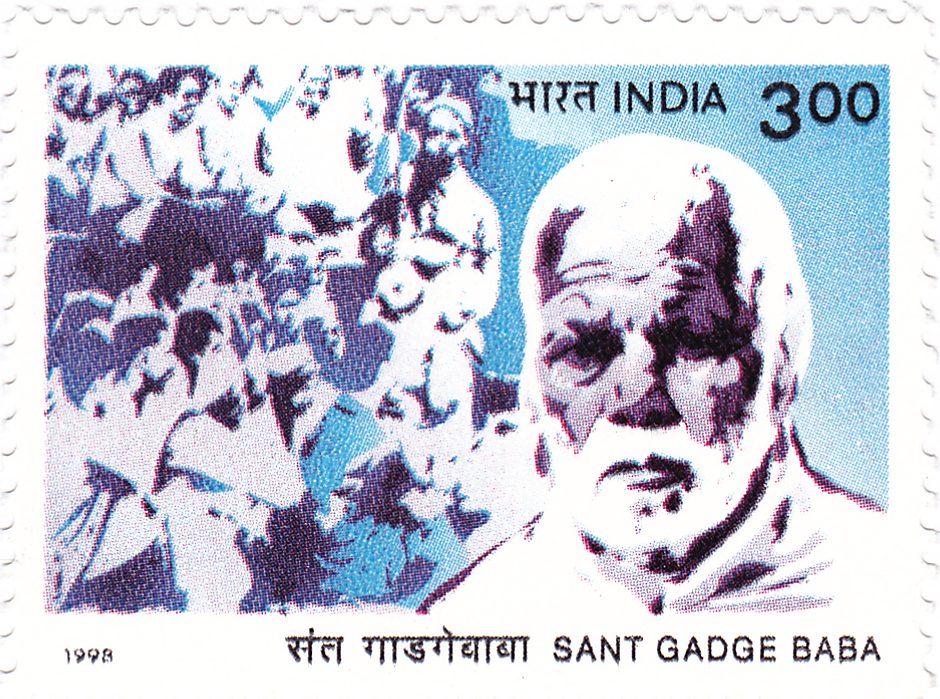
In 1998 India Post put him on a stamp. Amravati University was renamed Sant Gadge Baba Amravati University, so a man who never sat a degree examination is now the name on a university gate. In 2000–01 the Government of Maharashtra began the Sant Gadge Baba Gram Swachhata Abhiyan, a clean-village campaign that prizes villages for staying clean. That is the most exact memorial: not a statue, a competition to sweep.
Later national drives for sanitation have reached back to him as an ancestor. The comparison is fair as inspiration. It should not be stretched into a claim that he ran a government scheme. His scheme was a song, a broom, and buildings raised with other people’s money.
Jayanti, his birth anniversary, falls on 23 February. Punyatithi, the death anniversary, falls on 20 December. If you want to understand him rather than only remember the dates, the ten duties are enough. Feed someone. Teach a child. Do not ask a caste. Leave a place cleaner than you found it.
A fair last word. Dr Ambedkar’s reported praise was not that Gadge Baba was a mystic. It was that he was a servant of the people. The patched coat in the photographs is the evidence. So is the dharmashala he gave away.
Words and names
A small glossary
The life is full of Marathi words. None of them are difficult once they are said in ordinary English.
Gadge
An earthen pot. He ate and drank from one, and carried it on his head. The pot became the name. In Marathi: गाडगे.
Baba and Maharaj
Baba means father. Maharaj, “great king”, is what people call a saint. He ruled no land.
Kirtan
A public telling with song, story, humour and a moral. His were at night, after the sweeping, often for two or three hours.
Bhajan and abhang
A bhajan is a devotional song. An abhang is the Marathi verse form of saints such as Tukaram. He sang both, and he called Tukaram his guru.
Dharmashala
A rest house for travellers and pilgrims, often free or cheap. His were meant for people other houses turned away.
Gaushala
A shelter for cattle, tied to his refusal of animal sacrifice. Gorakshan is the work of protecting them.
Shramdan
A gift of labour. Sweeping with him was shramdan. Money was not the only thing he asked people to give.
Dashasutri
The ten-point teaching. Food, water, clothes, schooling, shelter, medicine, work, kindness to animals, simple marriages, courage.
Parit
The washerman community, his own. He refused to let that birth, or anyone else’s, decide a person’s worth.
Jayanti and punyatithi
Jayanti: the birth anniversary, 23 February. Punyatithi: the death anniversary, 20 December.
Gopala
A name of Krishna, son of Devaki. “Gopala, Gopala, Devakinandan Gopala” is the line he sang while he swept.
Karma yogi
A person whose worship is work without a claim on the reward. It is the title several of his biographers chose.
Questions
Short answers
Was he a priest, or the founder of a sect?
No. He was a wandering social reformer who used the kirtan, an old Maharashtrian way of teaching. He said he was nobody’s guru and had no disciples.
Why do pictures show him so poorly dressed?
Because that was the life, not a costume. The clothes were patched from cloth other people had discarded. The poverty was how strangers trusted him with money. He did not keep the money.
Did he go to school?
Accounts agree that he had little or no formal schooling. That is why his insistence on schools is striking. He did not romanticise ignorance. He called it a condition to be ended, especially for the children of the poor.
What is his link with Dr Ambedkar?
They met often and respected each other’s methods. In 1949 Baba transferred the Chokhamela dharmashala at Pandharpur to Ambedkar’s People’s Education Society. He told crowds to take Ambedkar’s learning as proof that education has no caste. Ambedkar is reported to have ranked him, as a servant of the people, just after Jyotirao Phule.
Did he found the Swachh Bharat Mission?
No. That is a government programme of a later time. He is one of its moral ancestors in Maharashtra, and the state already ran a village-cleanliness programme in his name from 2000–01. His own programme was a broom in his hand.
What should I read if I want one book?
In Marathi, Madhukar Keche’s Shri Sant Gadge Maharaj or G. N. Dandekar’s life. If you want his voice rather than his story, read R. T. Bhagat’s edition of the last kirtan. In English, Vasan Shirwadkar’s The Wandering Saint is the book to look for.
Sources
Where this page looked
This is a reading guide, not a new biography. Dates and events that the sources share are told as fact. Places where they differ are marked near the top. The photographs are the Wikimedia Commons files named under each picture.
- District Amravati, Government of Maharashtra. “Sant Gadge Baba.” amravati.gov.in
- Wikipedia. “Gadge Maharaj.” Birth, death, the broom, the ten duties, the Ambedkar relationship, the 1954 meeting, the stamp, and the Gram Swachhata Abhiyan. en.wikipedia.org
- Sant Gadge Baba Amravati University knowledge centre. The library list of books, and the short life on the same site. sgbaukrc.ac.in
- Sant Gadge Mission, Delhi. The village visit, the kirtan of 8 November 1956, and the remembered exchange with Dr Ambedkar. santgadgemission.org
- Wikimedia Commons, category “Gadge Maharaj,” for every photograph, the stamp, the drawing and the memorials. commons.wikimedia.org
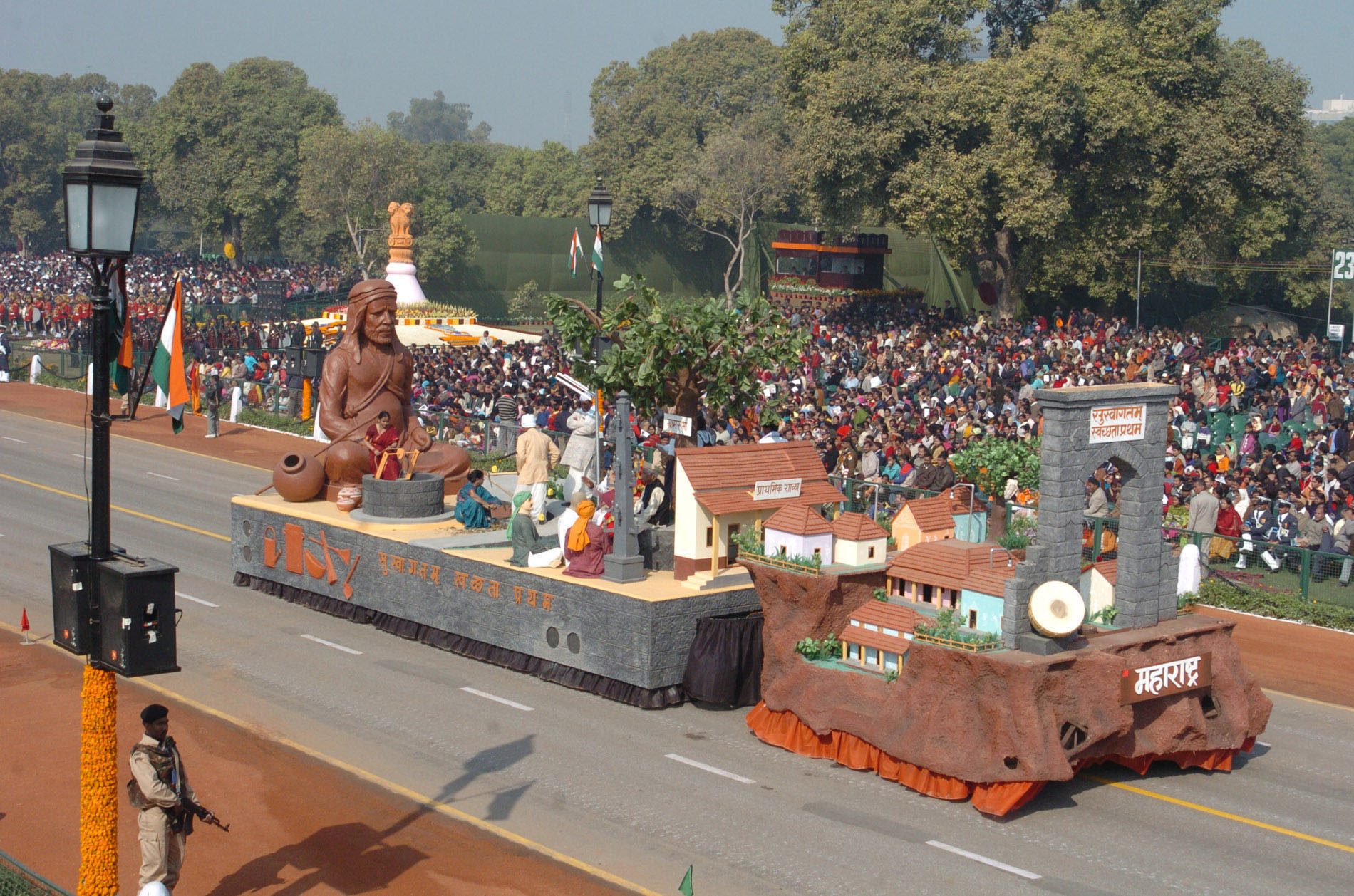
Photographs are shown so a reader can see the man. Reuse them only on the terms of each Wikimedia file page. The drawing is a drawing. The statues and the parade tableau are later memorials, and the captions say so.